

CREATIVITY
EXPERTISE
Jennifer Aboufadle Author | Teacher
Philosophy
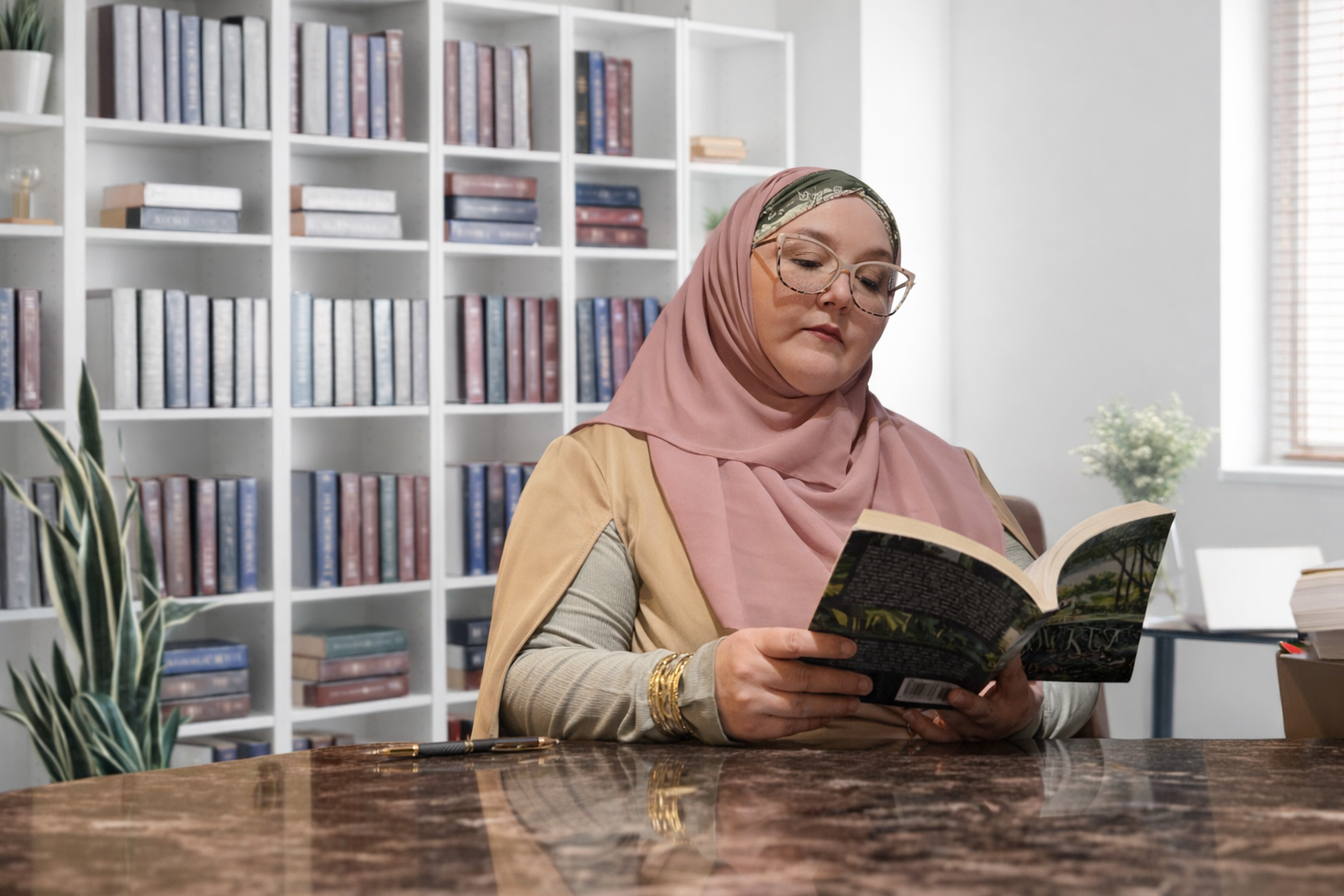
We write because silence is not enough. The act of putting words to page is a refusal to let our thoughts vanish unspoken, a way of preserving the fleeting sparks of imagination before they fade. Writing is not only about stories or characters—it is about shaping meaning, about leaving behind evidence that we were here, that we thought, that we dreamed.
I am a writer, educator, and speaker whose work centers Muslim identity, emotional truth, and imaginative possibility. My creative practice spans middle‑grade science fiction, young adult fiction, memoir, and children’s literature. My guiding commitment is to tell stories where Muslim characters lead, fight, dream, and transform.
Writer
·
Educator
·
Advocate
·
Writer · Educator · Advocate ·
Mission Statement
-
My broader creative trajectory is informed by my work in education, where I have facilitated inclusive classrooms across grade levels and supported multilingual learners through culturally responsive literacy instruction. These experiences have deepened my understanding of narrative as a tool for empathy, identity formation, and community connection. I approach writing as both an artistic practice and a form of service, grounded in the belief that stories can illuminate the complexities of lived experience while offering readers a sense of recognition and possibility.
My work is grounded in the belief that storytelling can cultivate empathy, affirm identity, and expand the imaginative possibilities available to young readers. I write narratives in which Muslim characters are rendered with depth, agency, and emotional complexity, and I approach both fiction and nonfiction with a commitment to intellectual honesty, cultural clarity, and craft. As an educator and writer, I aim to create literature that supports belonging, encourages critical thinking, and reflects the diverse realities of the communities I serve. My mission is to contribute to a literary landscape in which Muslim characters are portrayed with nuance and humanity, and in which young readers can encounter stories that honor their experiences and broaden their understanding of the world.
PUBLICATIONS
World Insane Literary Magazine, Issue .03 “Under Your Feet” (Jan 2025)
Blue Minaret Literary Journal “The Restaurant of Sand” (Jan 2025)
Independent Press Childhood Islamic Basics
Maryam Is Too Shy to Exercise (2022)
Fire on Mohammad’s Street (2021)
Emma Grows (2021)
Handwriting Workbooks (2021–2022)
BOOKS & CREATIVE PROJECTS
Childhood Islamic Basics Series — Author/Illustrator (2021–Present)
Phonics Stories for Muslim Kids — A Pre-K to 2nd grade series of stories in a single compiled text, designed to highlight Muslim kids as they learn and grow.
William and the Worry Germ — The fourth book in the Pre-K series about a boy who becomes scared to enjoy the fun of mud when he learns about germs and how he gets back to normal.
Abdel Can’t See the Bright Side — The fifth and final book in the Pre-K series about a boy who is overcome by negative thoughts and how he learns to let go of some of his worries.
Seeking Agent Representation
Cosmic Classmates Series – Middle grade series introducing science concepts in a future that still feels like modern classrooms.
Upcoming
Sunbirds Rising – Young adult or novella project completely for charity to rebuilding schools and education infrastructure.
Hiawassee – Young adult series that follows a young genius as she navigates stepping into adulthood and responsibility.
TEACHING & LITERACY EXPERIENCE
Kelly Education — Substitute Teacher (2024–Present)
Designed reading interventions for multilingual learners
Created visual and narrative supports to improve comprehension
Adapted instruction for culturally diverse classrooms
Community-Based ESOL Literacy Tutor (2022–Present)
Supported adult English learners through individualized literacy instruction
Developed culturally inclusive reading materials and activities
Child Literacy Facilitator — Parent-Led Instruction (2024–2025)
Designed home-based literacy programming for early readers
Fostered multilingual storytelling and creative expression
Customer Service Specialist — Clerk of Court (2022–2024)
Assisted training new hires in communication-rich environments
Demonstrated peer instruction and customer-facing problem solving
EDUCATION
University of Central Florida B.A. English: Creative Writing
University of South Florida M.F.A. English: Creative Writing (Expected 2029)
For Agents

I will be seeking literary representation for my series during my MFA. My MFA is to last through 2029. My primary project for querying will be Cosmic Classmates: A Bunch of Hot Air, the first book in a middle‑grade science fiction series. I also have additional manuscripts in development, including Sunbirds Rising (YA), the Hiawassee series (YA Sci‑Fi), and a memoir project.
My professional background includes extensive experience in education, ESOL literacy support, trauma‑informed classroom practices, and culturally responsive curriculum design. My MFA also includes an assistantship in teaching.
I bring a strong foundation in narrative craft, a clear artistic mission, and a long‑term commitment to producing work across multiple genres. I welcome inquiries related to representation, publication, and long‑form project development.
My memoir writing is a mixture of lived experience and the meaning I want my work to carry. These pieces splice together moments of faith, motherhood, and transformation with reflections on identity and resilience. They are not only personal stories but also explorations of how narrative can preserve erased voices and illuminate the emotional architecture of everyday life.
This memoir explores the interwoven legacies of maternal love, silence, and depression across generations. Beginning with childhood memories of fear and secrecy, it traces how the author’s mother’s struggles with shame and neglect shaped her own confrontation with sadness and the decision to seek help. Anchored in the tension between inheritance and transformation, the piece reflects on how memory can guide resilience, how naming a daughter becomes an act of reclamation, and how caring for oneself becomes both survival and legacy.
This memoir reflects on a mother’s quiet descent into depression and a daughter’s inability to recognize it as a cry for help. Living in a loveless marriage, mocked and diminished by her husband, the mother withdrew from public life until even grocery trips became unbearable. As a child, the author could not understand why her mother failed to see her own worth and beauty. Years later, crushed by her own depression after becoming a parent, she confronts the echoes of that silence and resolves to break the cycle.
Unlike The Sad Apple Tree Bears Fruit Too, which centers on the author’s discovery of her mother’s depression through memory and its impact on her own struggle, this piece focuses on the mother’s lived experience of quiet self‑destruction and the daughter’s later recognition of its generational weight. Together, the two works form complementary explorations of maternal legacy—one through remembered childhood moments, the other through adult reflection and resolve.
In this memoir, the closet becomes both sanctuary and prison, a space defined by light and darkness. As a child, it offered refuge from the chaos of parental conflict, yet when the light was off it transformed into a site of terror, filled with imagined demons that mirrored the fear at home. Reflecting later in life, the closet seems insignificant, but in memory it reveals how childhood survival strategies were shaped by abuse, silence, and the fragile balance between safety and dread. Now, approaching her late thirties, the author considers how much of that fear was born from her parents’ relationship, and how the nightmares that remain are echoes of a past she continues to confront.
A child grows up in a house where danger hides in plain sight, where spiders in the shower are easier to face than the man raising her. This memoir follows a daughter shaped by violence, neglect, and the constant recalibration of what “normal” means when survival becomes instinct. The narrative moves between past and present—between a childhood spent navigating a father’s rage and a womanhood spent unlearning the reflexes he left behind. Scenes of abuse, abandonment, and psychological manipulation unfold alongside moments of fragile refuge: a grandmother’s carport, a mother trying to hold herself together, and later, the quiet steadiness of the narrator’s own husband and children. Through vivid imagery and emotional precision, the story examines how trauma embeds itself in the body, how memory lingers in the ribs long after bruises fade, and how breaking cycles of harm requires both courage and clarity. At its core, this is a memoir about choosing safety over blood, truth over obligation, and learning to step out of the shadows of a father who never earned the title.

Fiction

-
Told from the perspective of prayer rugs, Under Your Feet is a lyrical meditation on devotion, neglect, and resilience. Once central to a mother’s nightly prayers and tears, the rugs recall the intimacy of holding her weight, absorbing her sorrow, and bearing witness to her faith. As family conflict and heartbreak harden her spirit, the rugs are folded away, left to wait in silence for her return. Through their voice, the piece explores the tension between ritual and rupture, the quiet endurance of objects imbued with memory, and the longing for spiritual reconnection.
World Insane Literary Magazine Issue #3 Published Jan 20th 2026
The Restaurant of Sand transforms a place of hospitality into a sanctuary of memory and resistance. Once a kitchen of mercy, the restaurant becomes an archive where bowls of sand replace food and guests offer grief, ritual, and remembrance instead of orders. Each visitor carries a story—a mother’s last meal, an exile’s map, a chef’s fragrant legacy, a convert’s first fast, an elder’s spices, a silent olive. Their offerings are recorded in a ledger that preserves not consumption, but survival. Through vivid sensory detail and ritualized storytelling, the piece explores themes of famine, erasure, and resilience, showing how memory itself can nourish and resist what hunger seeks to erase.The Blue Minaret Published Jan 29th 2026
Pre-K Series by small independent press Islamic Childhood Basics
Emma Grows — Published May 26, 2021
Emma Grows is a picture book that helps young children understand patience through the story of a little girl frustrated by how slowly her plant grows. Guided by her teacher, Emma learns the Islamic value of sabr and discovers that growth—whether in plants or people—takes time. The book also includes natural representation, featuring an adult who uses a wheelchair to encourage early conversations about inclusion. Written for preschool and early elementary readers, Emma Grows supports emotional development while introducing gentle, faith‑aligned lessons.
Fire on Mohammad’s Street — Published August 13, 2021
Fire on Mohammad’s Street follows a young boy who learns firsthand that fire, while exciting, carries real consequences. As Mohammad tries to help others in his neighborhood, he quickly discovers how overwhelming and dangerous fire can be. The story introduces children to safety awareness while weaving in the Islamic value of charity, encouraging young readers to connect their actions with their faith in positive, meaningful ways. The book concludes with simple fire‑safety instructions designed for families to review together.
Maryam Is Too Shy to Exercise — Published April 8, 2022
Maryam Is Too Shy to Exercise follows a preschooler learning how her bones, muscles, heart, and lungs all need movement to stay healthy. Even though her mother takes her to the park, Maryam is too shy to join the other children and struggles to get the exercise her body needs. With gentle encouragement and a chance at new friendship, she begins to discover confidence and connection. Part of the Pre‑K Collection by Childhood Islamic Education, this story introduces early health concepts alongside social‑emotional growth for young readers.
Pre‑K Handwriting Workbooks — Published 2021–2022
This three‑part Pre‑K workbook series introduces early learners to the English alphabet through guided handwriting practice featuring the familiar characters from the author’s picture books. Each workbook is designed to support preschool and kindergarten readiness with developmentally appropriate tracing, letter formation, and fine‑motor exercises. The extended editions also include introductory Arabic alphabet pages, and the longest workbook adds puzzles and coloring activities to reinforce learning through play. All illustrations and workbook designs were created by Jennifer Aboufadle, offering young readers a cohesive and engaging early‑literacy experience.
-
Grave Spaces
Grave Spaces imagines the afterlife through the voice of a soul resting in the grave alongside an angel named Adil. In this lyrical meditation, time dissolves into mystery as the narrator reflects on life, death, and the comfort of companionship beyond mortality. The piece blends spiritual imagery—gardens of golden flowers, lakes of stars, iridescent butterflies—with quiet dialogue that reveals longing, peace, and the anticipation of resurrection. More than a vision of what lies beyond, it is a meditation on patience, divine mercy, and the solace found in unexpected companionship.
Tea For the Hollow Man
Tea for the Hollow Man explores the quiet unraveling of a woman’s inner self as she endures the emotional erosion of an abusive marriage. Told through the shifting voice of her fading interior consciousness, the piece transforms a simple tea ritual into a surreal meditation on identity, fear, and the slow hollowing that comes from being endlessly diminished. Domestic objects warp into symbols of psychological danger—mint leaves blackening, sugar cubes melting into shadow, rooms tightening like a fist—while memories of gentler moments flicker like fragile light. More than a portrait of abuse, it is a study of how a self fractures under manipulation, and how even in the darkest unraveling, a small pulse of self‑recognition endures, waiting to be reclaimed.
Islam and the Masks
Islam and The Masks is a speculative narrative that begins in the sacred rhythm of prayer and erupts into violence, tracing the aftermath of faith interrupted by bullets and fire. The narrator, left paralyzed and hospitalized, confronts a new world where grief and devotion are mediated through algorithmic companions and emotional regulation masks. Between memories of communal worship and the sterile presence of a machine‑like caregiver, the piece explores themes of identity, surveillance, and resistance. At its core, it asks what remains of faith when ritual is fractured, when belonging is prescribed, and when silence becomes the only authentic protest.
Threadfall
Threadfall is a speculative narrative that begins with a prayer mat humming beneath the narrator’s hands, unraveling her into a realm stitched with dust, copper clouds, and memory. In this world, verses from the Qur’an reshape the land—streams flow, trees bloom, ruins whisper—while the narrator wrestles with feelings of unworthiness and invisibility carried from her earthly life. Guided and tested by Huda, a figure both mentor and skeptic, she confronts the tension between being chosen and being forgotten, between silence and surrender. The story blends mysticism, science‑fiction textures, and spiritual longing, ultimately asking whether faith is about returning home or rooting oneself in a new, transformative landscape.
The Goodbye of Beginings
The Goodbye of Beginnings is a lyrical fable told through the voices of birds, trees, and a boy named Zaid. Set against a mountain landscape alive with prayer, memory, and wind, the story explores themes of belonging, departure, and the bittersweet beauty of farewells. As Zaid prepares to leave the mountain and return to the village, the natural world around him—saplings, nests, and the elder tree Amil‑hajj—responds with grief, love, and transformation. The piece blends mythic imagery with intimate emotion, showing how goodbyes can be both endings and beginnings, carrying memory forward in roots, ribbons, and prayer.
The Hafiz
The Hafiz is a short narrative set in a traveling coalition, where faith and survival intertwine at dawn by a murky lake. When an elderly man appears, frail but declaring himself a Hafiz of the Qur’an, the narrator balances caution with reverence. His presence transforms the camp: children learn, prayers echo, and hardship is softened by recitation. Through vivid scenes of vigilance, tenderness between siblings, and the fragile authority of the Hafiz, the piece explores themes of trust, devotion, and the sustaining power of scripture in times of uncertainty.
-
Upcoming Project: Cosmic Classmates
I’m excited to share my work‑in‑progress, Cosmic Classmates—a middle grade space adventure that blends science, faith, and friendship. Set in a future where young Muslim students journey beyond Earth, the story explores how curiosity and conviction can coexist among the stars.
At its heart, Cosmic Classmates is about belonging: how friendships form across cultures and galaxies, how science and spirituality spark wonder together, and how young readers can see themselves reflected in stories of exploration. With humor, adventure, and heartfelt moments, the series invites children to imagine futures where diversity is celebrated and discovery is shared.
This project marks the next stage of my writing journey, building on my Pre‑K series (Childhood Islamic Basics) and moving toward middle grade and YA works I’ll continue developing during my MFA and beyond.